Friday, 21 August 2009

Venice... still the most romantic

Venice in Summer: hot, sticky, crowded, and yet still the most romantic city in the world...


It's often said that nothing changes; the elegant waiters edge between tables on the Piazza San Marco where they charge €9.50 (about $13.620) for a cup of espresso caffe.

But, but, but... there are some awful things happening. What have they done to the Bridge of Sighs? Giant hoardings have taken away all context, all relevance from the bridge that led from the old prisons to the interrogation rooms in the Doge's Palace. The view from the Bridge of Sighs was the last view of Venice that convicts saw before their imprisonment. The bridge name, given by Lord Byron in the 19th century, comes from the suggestion that prisoners would sigh at their final view of beautiful Venice out the window before being taken down to their cells.

Seen in January 2008, it's obvious what it's all about. The Palazzo dei Dogi is on the left and the Piombi (the leads - see http://en.wikipedia.org/wiki/Piombi for explanation) on the right.


The Rialto is always the Rialto, and, indeed, it seems to need the tourist crowds to fulfil its purpose and bring it to life.


There are, of course, all the tiny sottoporteggi and the calli that exit suddenly onto a hidden canal. This, I thought, was a good photo, but, unfortunately the gondola's occupants couldn't resist waving.


Who do you love, my friend?

Nobody as much as myself!

San Giorgio Maggiore, where all the Tintorettos (Tintoretti???) are. Must get over there later.


We took the opportunity of our long-term vaporetto tickest to show some new friends the islands of Murano and Burano. Murano is where the glass comes from, though I'm sure much of the cheaper stuff in the shops comes from China. The Muranesi are running a positive campaign saying "Nothing in this shop comes from China. Stop killing Murano."

We found this small palazzo and thought we might buy it as a holiday home. Looks like it needs a LOT of work!

This is Marea on the bridge over Murano's main canal. This was a very hot day - about 32°C (90°F) and very humid. We took the vaparetto to Burano where all the coloured houses are. and they sell lace instead of glass.

This was Sunday morning, so all the locals were in church or visiting the cemetery on San Michele with large bunches of flowers.

It livened up later and we had lunch in a very good fish restaurant. Risotto and tagliatelle (not both, but between us).


Getting back to the Michelangelo, we found we had been upstaged by a bigger and better boat. this was fenced off and had a private office erected on the Riva Sette Martiri to make sure no-ne got in who wasn't welcome. Don't know who it belonged to, but we saw nobody either on board or coming and going.


This was the only bad weather we had; the weather forecast before we left England predicted rain 3 days out of 5, but we know what to do with weather forecasts, don't we! Barbeque Summer - HA!


The thunder clouds gradually rolled in and gave us a wonderful sunset and thunder & lightning after dark.


Next day, we got up early and went down to queue for St Mark's. Because we were their before opening time, we didn't have to wait too long, nor stand in the hot sun.

St Mark's is very beautiful inside, but rather dark. The camera makes the light appear much better than it really is. However, the mosaics are remarkable and you can see something of the development of the building over all those centuries.


Then we decided to keep our appointment with Tintoretto...


Via Titian... These are in Santa Mariea Della Salute. I could rapturise about Titian and Tintoretto and all the other Venetian School painters, but I'm sure you know all about them (if not, try Wikipedia).


Then back on the vaporetto, across the lagoon to San Giorgio.


Where the Tintorettos are placed all around the hexagonal walls. They are completely open to the atmosphere and could do with a clean, but the camera brings out the colours and the fabulous technique. It's hard to believe that these paintings are over 400 years old. I think of Tintoretto as the archetypical Venetian painter and he's usually described as the last great painter of the Italian renaissance.

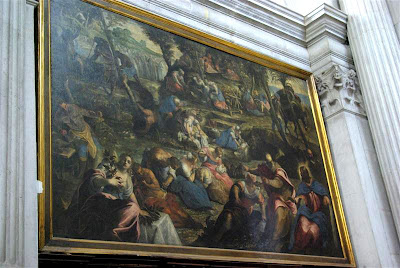

It's wonderful to stand in front of these great paintings (particularly the Last Supper) without museum guards, or indeed anyone else keeping an eye on you. We also went to Ca' Rezzonico to see the Tiepolo frescoes which are, I have to say, my absolute favourites, but they don't allow photographs in there. You can see a couple of the Punchinello frescoes at http://www.savevenice.org/site/pp.asp?c=9eIHKWMHF&b=67645 and at http://www.museiciviciveneziani.it/frame.asp?pid=423&z=2&tit=Percorsi%20e%20collezioni


So we then went off to Chioggia, which, because it wasn't market day unlike the last time we were there, wasn't terribly interesting. (I did take this rather arty shot.) Last time, the temperature was about zero degrees; we had snow and sleet, Marea bought a rather fetching hat to help her keep warm...


... and we retired to the Bar Aurora, a real fisherman's bar, with real fishermen, to drink coffee and get warm.


This time, the bar seemed closed, so we went elsewhere, but as we made our way back to the dock, it began to open for the afternoon. Just bad timing, I guess.


Last day... we went to see the early markets West of the Rialto, then made our way via vaporetto to Ca' Rezzonico (which I can recommend if you've got at least half a day to look around a gallery) to the Accademia where we sat outside and had pizzas and cool white wine while watching the gondlas and vaporetti going back and forth.

BLISS!

Thursday, 6 August 2009

Rowan Berries; and a new home for Museum Studies

I was going to include some photos in this entry about butterflies and blackberries, just to show that Autumn is on its way. unfortunately, they are on the wrong SD card in the wrong camera, so that's that!

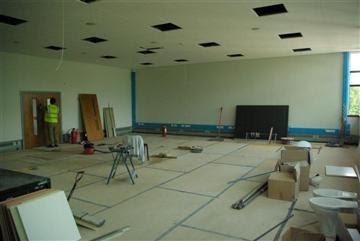
Anyway, to make the point, the Rowans are heavy with berries, especially the one outside the School of Museum Studies new building.


If you want a better look at the new building (work in progress) go to http://www.le.ac.uk/ms/news/newhome.html.

The frightening point is that there will only be a few days after I get back from leave before we move and I've still got loads to pack (and throw out).


What can you do with Rowan Berries? Well they make a very acceptable light, dry, rosé wine. in our younger, more pecuniarly challenged days, we made lots of this and served it at our dinner parties (very sophisticated) and everyone enjoyed it. Here's a quick basic recipe:

Ingredients:

2.25kg rowan berries
1.2kg finely granulated sugar
5l unchlorinated water
1 large lemon (zest and juice only)
1/2 tbsp pectic enzyme
1 tsp yeast nutrient
Montrachet wine yeast

Campden tablets for sterilizing demijohns and bottles

Method:
Preparation


Sort and wash the berries for soundness and crush in a fermenting bucket. Boil together the water and sugar and pour over the fruit.

Mash roughly with a sterilized potato masher then add the lemon juice and zest and allow to cool. Add the pectic enzyme and yeast nutrient and allow to sit in a warm spot for 12 hours. Add the wine yeast, wait until the fermentation starts then stir daily for a week.

Strain the liquor into a fermentation jar (demijohn) and top-off with water if required. Add a sterile bung and fermentation lock and allow to ferment for three months.

At this time rack into your second fermentation jar add a bung and fermentation lock and leave for a further month.

Your wine is now ready to rack into bottles. Once corked, leave the rowan wine in a cool dry place for at least ten months before tasting or one year for best results.

I added the Camden tablets as I think they are essential. They can also be used to stop fermentation before bottling (unless you're interested in malolactic fermentation - Google it!). I also never bothered about unchlorinated water - the chlorine evaporates readily when the water is heated.

This recipe comes from Nemeton: home of ancient recipes: http://www.celtnet.org.uk/recipes/brewing/fetch-recipe.php?rid=rowan-berry-wine
http://www.celtnet.org.uk/recipes/brewing/wine-recipes.php

In fact this is a pretty good site with all sorts of ancient/modern and ethnic recipes if you're prepared to dig a little: http://www.celtnet.org.uk/

Friday, 31 July 2009

Early Autumn, and the new stained glass

Now that we seem to have come almost to the end of the 'Barbeque Summer' that never was, though we did have a rather good May and June - Wimbledon went off almost without a hitch.... Anyway, now the allotments are burgeoning, and we are on the brink of a glut of beans and tomatoes.

There are also a few more exotic vegetables such as this artichoke. (We once caused what we have always thought of since as 'the middle-class kitchen catastrophe of all time when we jammed solid the waste disposal with artichoke leaves.)

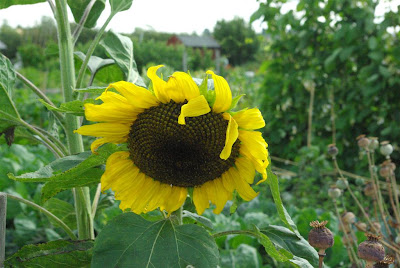
Lots of sunflowers which, having satisfied the bees with nectar, are now providind a food source for the birds.

And, rather surprisingly for July, the Blackberries are already ripening.


There's also lots of this - Bindweed; the bane of our own garden. Funny how some gardens, like our last, are totally free from it, while it springs up everywhere in the present garden.


I've taken to looking very carefully at all the local stained glass in order to learn how it was done. Joints and came thickness are all a bit archaic.


So, I started a new design for the second window I intend to replace. I thought of something a bit more adventurous this time, with slightly more complex shapes and rather more elegant borders. This is the design after I changed my mind about putting some bevels in and had to make a couple of changes to accommodate them.


I started to cut, and was rather pleased with the choice of glass, particularly the Kokomo Restoration glass in Wedgwood Blue. The small diamonds look a bit like jewels.

I was busy cutting the borders from the glass I originally bought at Pearsons when I went up for my day class in leaded lights. I really like the green water glass.


But it cuts so easily that when I made one cut and picked up the sheet, it fell away and I broke the stupid thing!


So now, I'm short of one green border section and have had to send to Tempsford (my best supplier) for some more.


Meanwhile, taking the dog for a walk along the backs, I saw this rather Mackintosh-looking bindweed. I think I'm starting to see everything in terms of stained glass designs!


Friday, 24 July 2009

Stained Glass; the result in situ

Finally, this is my first finished stained glass leaded light, installed in its proper place and with the light from the hallway shining through.


Below is the inside view taken with flash which shows up all the textures and also the minor damage to the door caused when I took out the old window, not realising that the beading on one side had been firmly glued in. I, of course, chose the wrong side to remove.


As you can see from the pic below, it transmits the light beautifully and makes it actually seem brighter than when the glass was clear (but ugly and bobbly).


Here you see how it fits in with the room. The window at the left (bottom of the stairs) is a candidate for a more art deco design I'm working on.

Friday, 17 July 2009

Stained Glass - the finished article

As I write this, the rain is hammering down outside and the thunder is crashing. Last weekend was a bit wet as well, so it gave me the chance to finish the stained glass window. I cut and fitted the final pieces, soldered all the joints, turned it over and soldered the back (though which is front and which is back, who knows?)

The next stage was unphotographable (at least, I wasn't prepared to risk my camera). All the leads had to be cemented by forcing the cement into the gap between lead and glass, then covering it with 'whiting' (powdered chalk) to soak up the excess and begin the drying process. The chalk has then to be vigorously brushed off, darkening the lead and polishing the glass. Over the next 48 hours, as the cement sets, the excess that oozes out has to be scraped away with a fid until, eventually, the whole thing is clean and rigid.

There are 2 ways of seeing this glass; the picture above, using ambient light, looks straight through the glass, giving a bright, sharp image, but the picture below, taken with flash, picks up the textures in both glass and lead. I don't know which is better - both reveal something different.

Meanwhile, the garden continues to burgeon, giving me lots of ideas for future glasswork. These are Allium sphaerocephalon seen through the railings at the front of the house. Unlike other alliums, they don't have untidy foliage and the colour against the white stucco is gorgeous. they last quite a long time as well.


This is the potted olive tree (or the tip end of one of its branches) that we bought at Cottesbrooke this time last year. I wonder if the olives will develop, but perhaps our summer isn't long or hot enough.


Finally, one of our better hanging baskets. Verbena does very well, lasts and provides lots of colour - must remember that next year.